Highlights from our group — awards, new arrivals, new grants, press releases, and our latest papers.
News
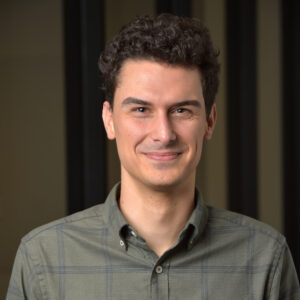
Chris O’Connor’s work highlighted in AAS Nova
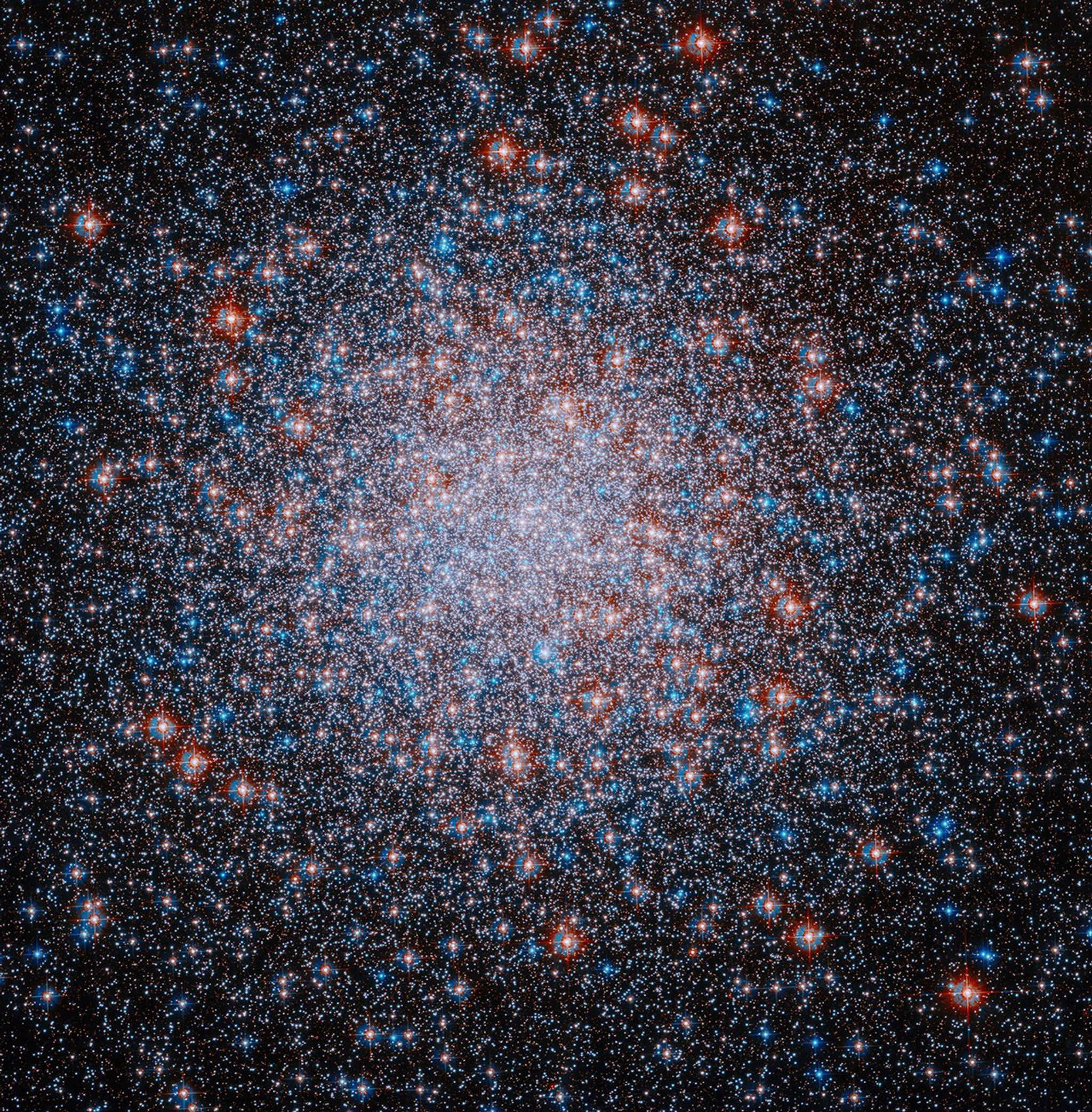
AAS Nova highlighted work led by CIERA Postdoctoral Fellow Chris O’Connor on a long-standing puzzle: why do globular clusters contain far fewer binary stars than the solar neighborhood? Using our group’s Cluster Monte Carlo code, the team showed that “black hole burning” — energy pumped into the cluster core by black holes — destroys wide binaries over billions of years, so clusters and the field could have started with the same primordial binaries after all. Read the AAS Nova story.

Elena González Prieto named Presidential Fellow
My graduate student Elena González Prieto was inducted as a Northwestern Presidential Fellow on September 28, 2026 — the University’s most prestigious honor for graduate students, recognizing outstanding scholarship and research promise. Elena is developing machine-learning methods to predict the outcomes of stellar collisions (the collAIder project).
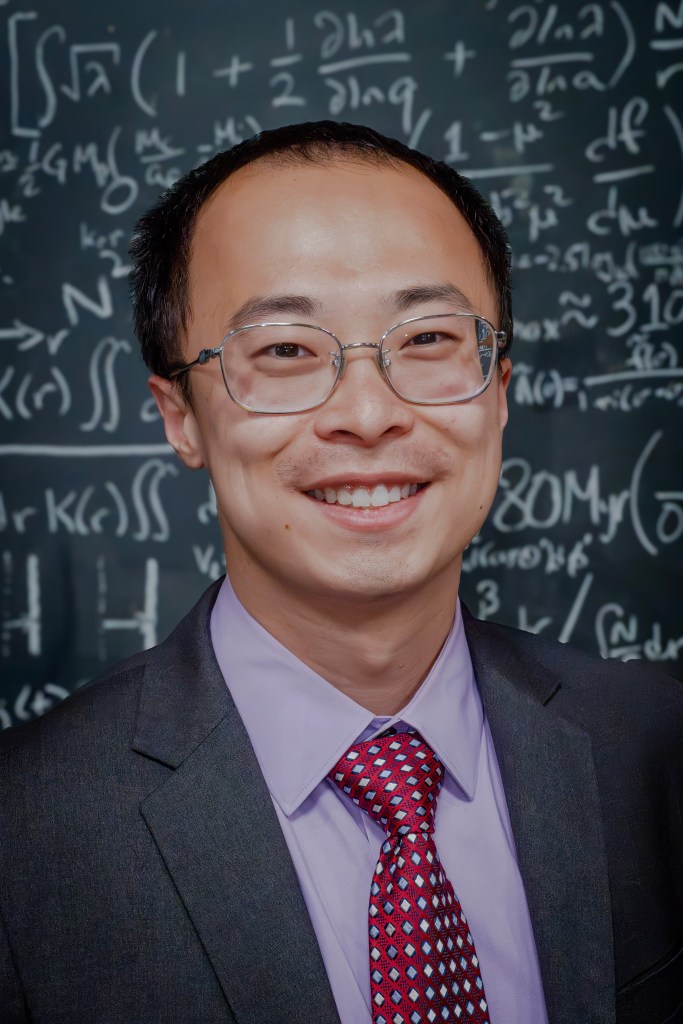
Nicholas Rui (former REU student with us) joins CIERA as NASA Hubble Fellow
Nicholas Rui joined CIERA this August as a NASA Hubble Fellow — returning to the group where he once worked as an REU student. He works on stellar oscillations, mergers, and magnetic fields — bringing new expertise on what happens inside stars to our dynamics and hydrodynamics projects.
Inducted into the American Academy of Arts and Sciences
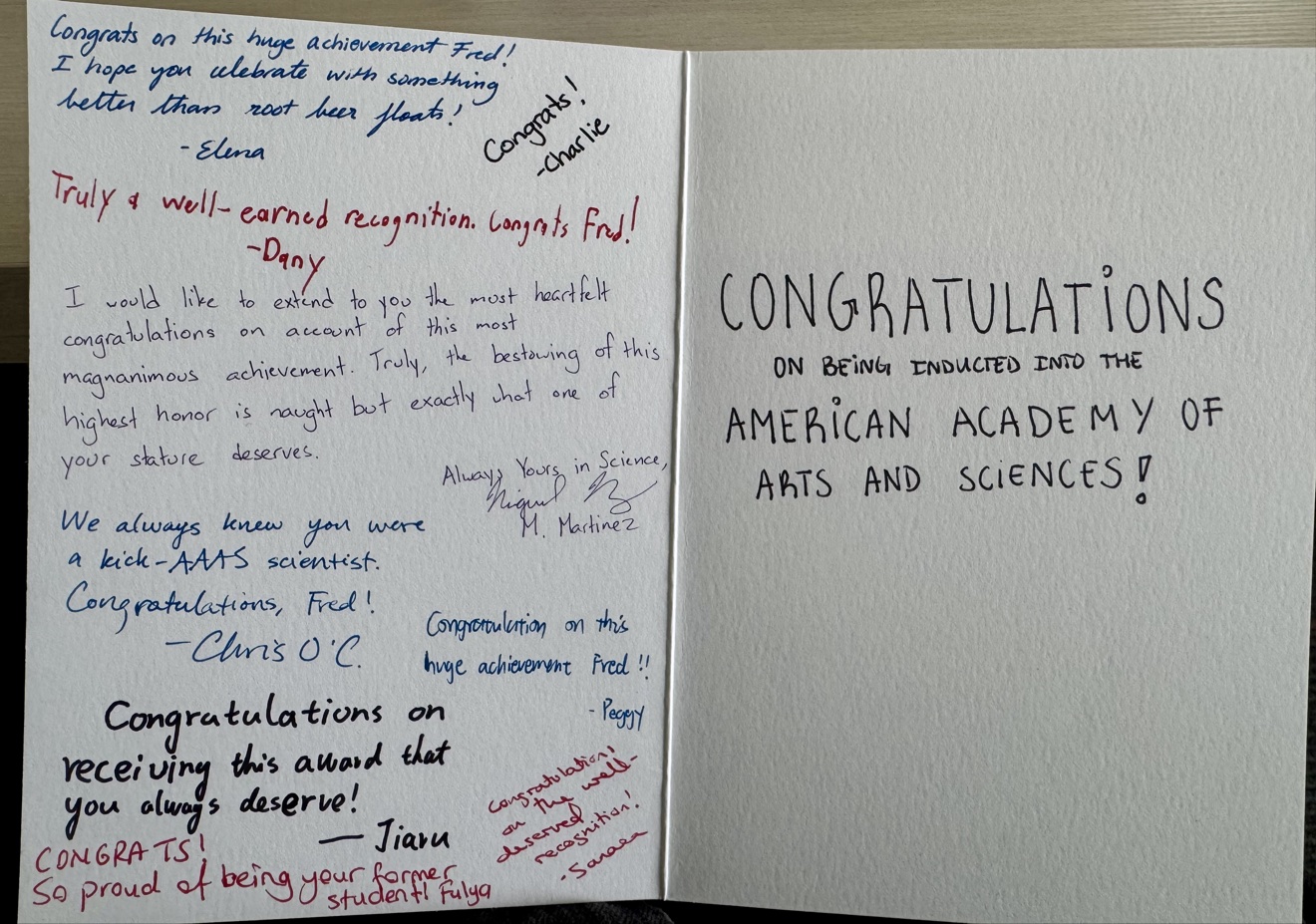
The American Academy of Arts and Sciences inducted its 2025 class in October 2025, at the ceremony in Cambridge, Massachusetts. Founded in 1780, the Academy is one of the nation’s oldest and most prestigious honorary societies. New members sign the Academy’s historic Book of Members — a tradition going back to Benjamin Franklin and George Washington.
Pictured: the card my group gave me — much better than a photo of me in a suit.
New NSF grant: modeling dense star clusters from cosmic dawn to the present
Our group was awarded a new three-year NSF grant ($587,631) for “Modeling Dense Star Clusters from Cosmic Dawn to the Present” (PI: Fred Rasio; co-PI: Tjitske Starkenburg). The project combines large-scale cluster simulations with new analysis methods to follow dense star clusters — and the black holes they produce — across the history of the universe.
A cosmic love story: black hole spins align in a Valentine's embrace
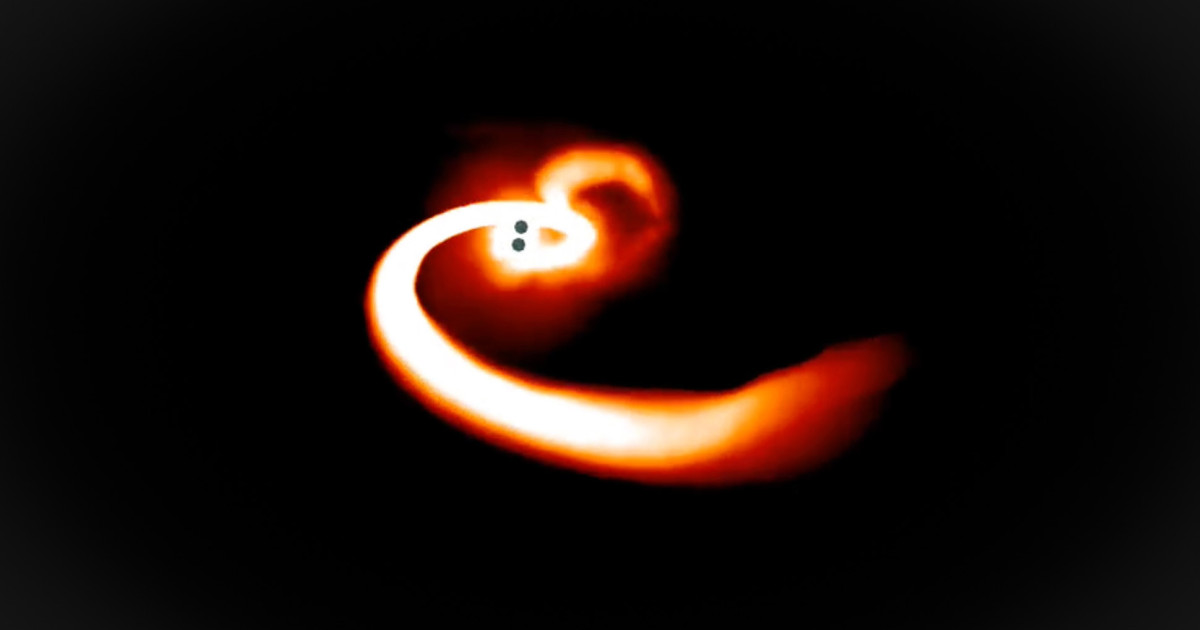
Work led by Fulya Kıroğlu showed that binary black holes in dense star clusters can align their spins before merging — as suggested by some LIGO/Virgo gravitational-wave signals. When a binary black hole tears apart a massive star, the debris it gobbles up gradually syncs the black holes' spins with their orbital motion. The simulation even renders the debris as a googly-eyed heart. Read the Northwestern news story.
Recent Papers
What our group has been producing most recently:

This work, led by graduate student Tristan Sand, uses machine learning to predict what happens when stars collide in our own Galactic Center. Direct collisions in the inner parsec can completely reshape stars’ orbits and properties — and with emulators trained on hydrodynamic simulations, we can now model these outcomes in a fraction of the time.
This work, led by graduate student Amanda Newton, demonstrates how intermediate-mass black holes can grow through repeated (hierarchical) mergers of stellar-mass black holes in the nuclear star clusters surrounding supermassive black holes — a promising formation channel for some of the most intriguing gravitational-wave sources.
This work, led by graduate student Elena González Prieto, introduces the first paper in our collAIder series: machine-learning methods that predict the outcomes of stellar collisions — mass loss, remnant properties, and more — directly from the initial conditions, bypassing expensive hydrodynamic simulations.
This work, led by graduate student Maia Martinez, challenges the common assumption that the spin-orbit angles of binary black holes in dense clusters quickly become completely random. By modeling successive gravitational encounters as a random walk, it tracks how the tilts actually evolve — with direct implications for interpreting the black-hole spins measured by LIGO.